Guides
Clearing Out Business Records Before an Office Move: What to Keep, Scan or Shred
Sort before you shred: most tax records are kept for 5 years, but company records and staff time and wages records are kept for 7, and asset records for as long as you hold the asset plus 5 years after you dispose of it, so check each box's category first and send only what can go to secure destruction, never the skip.
Four keep-until clocks in one filing cabinet
Most tax, super and registration records: 5 years (start point varies; some kept longer) ATO
Company records (ASIC, as stated by the ATO): 7 years ATO
Employer time and wages records: 7 years Fair Work Ombudsman
Depreciating and CGT asset records ATO
while you hold the asset5 years after you sell or dispose of it
Years kept (0 to 12)
Records used in a later return are kept until that return's period of review ends.
Before any box goes to the shredder or the truck, know this: an ordinary small business's records run on at least four different keep-until clocks, not one.
Here is how we counted them. The ATO says most tax, super and registration records must be kept for 5 years. The same ATO page says ASIC requires companies to keep records for 7 years. The Fair Work Ombudsman says employers must keep time and wages records for 7 years. For depreciating and CGT assets, the ATO says to keep the record for as long as you hold the asset, then another 5 years after you sell or dispose of it.
So a box marked "older than five years" can still hold records you are required to keep. Treating every record as a five-year record is an easy slip: business.gov.au says company records and some employee records are kept for 7 years, and the ATO says some tax records must be kept longer than 5 years.
At Castle Hill Removals, the order we suggest for any office clear-out is this: work out what must stay, destroy what can go securely, then pack. The rest of this guide follows that order.
When does the five-year clock start?
| Record | The 5-year clock starts from |
|---|---|
| Most tax, super and registration records | when the record was prepared or obtained, or the transaction was completed, whichever is later |
| FBT records | the date the FBT return is lodged |
| Employee super contribution records | the date of the contribution |
| Super fund choice records | the date of engagement or the choice |
| Records used again in a later return (for example, working out a business loss carried forward) | not a 5-year clock: keep until the period of review of the later return has ended |
For most records, the clock generally starts from when the record was prepared or obtained, or the transaction was completed, whichever is later.
Some records start counting from a different point. On the same page, FBT records run from the date the FBT return is lodged. Employee super contribution records run from the date of the contribution. Super fund choice records run from the date of engagement or the choice.
Five years is not always the end, either. The ATO says some records must be kept longer than 5 years, including records that cover the period of review for an assessment that uses them. Its example is a business loss carried forward: the records that worked out the loss stay until the period of review of the later return that used it has ended.
Which shelf does this record go on?
Worked example
A sole trader's supplier invoice, received and paid in March 2021, not tied to an asset or a later return. Clock starts March 2021, so it sits on "5 years", kept until at least March 2026, and can come off the shelf now. Switch "company" to Yes and the same invoice moves to "7 years".
General guidance from the ATO, Fair Work and SafeWork NSW pages; check with your accountant.
Pick the kind of record and say whether the business is a company, and the sorter puts it on a shelf. Our approach is simple. Where two clocks apply, the longer one wins. Anything that fits no shelf stays in the office and goes on a list for your accountant.
Here is a worked example. A sole trader has a supplier invoice, received and paid in March 2021. The clock runs from the later of when the record was obtained or the transaction was completed, so it was kept until at least March 2026 and can now come off the shelf. The exception is a record used again in a later return, which stays until that return's period of review has ended.
Put the same invoice in a Pty Ltd's files and it lands on the seven-year shelf, because ASIC requires companies to keep records for 7 years.
Staff files carry two clocks
| Staff record | How long | Source |
|---|---|---|
| Some employee tax and super records | 5 years | business.gov.au |
| Time and wages records (cannot be changed except to correct an error; legible, in English) | 7 years | Fair Work Ombudsman |
| Resumes, contracts, performance reviews, trade certificates | 'A good idea' to keep; not a legal minimum | business.gov.au |
| Register of workplace injuries and illnesses, and records of notifiable incidents | Required to keep; leave out of the clear-out until SafeWork NSW confirms how long | SafeWork NSW |
One staff folder can hold records on two different clocks. Business.gov.au puts it plainly: some employee tax and super records are kept for 5 years, while some employment records are kept for 7.
The Fair Work Ombudsman says time and wages records must be kept for 7 years. They cannot be changed except to correct an error, and they must be legible and in English. Employment records include super contributions, leave, and how employment ended. Because super contributions appear on both lists, our suggestion is to keep them for the longer seven years unless your accountant says otherwise.
A staff member leaving does not put their folder in the clear-out. A former employee can still ask to see their records. If records are not kept, inspectors can issue an infringement notice, and in some cases the employer may have to prove to a court that they did not underpay.
Some papers are worth keeping even with no legal minimum. Business.gov.au lists resumes, contracts, performance reviews and trade certificates as "a good idea" to keep.
Safety records need their own pile. SafeWork NSW requires a register of workplace injuries and illnesses, kept in writing or electronically, plus a record of each notifiable incident. Keep both out of the clear-out until SafeWork NSW confirms how long yours need to stay.
Can a scan replace the paper original?
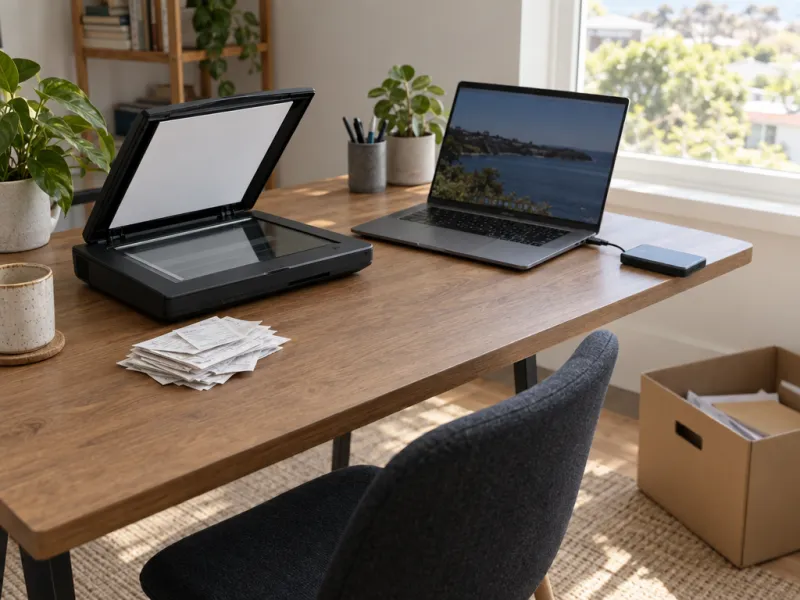
Yes, with conditions. If you keep digital images of paper records and they are a true and clear reproduction that follows the record-keeping rules, you no longer need the paper originals. That can take whole archive boxes off the truck.
The scan then becomes the record, so look after it. Business.gov.au says to back up digital records and, if possible, keep a secure off-site copy. The ATO adds that records must be stored so they cannot be changed or damaged, and you must be able to reconstruct original data if your record-keeping system changes.
An office move is often exactly when the system changes: new computers, a new internet connection, a new place for the server. Our office relocation IT checklist covers the backup side. One more point: if records are encrypted or password-protected, the ATO can ask for the keys or passwords, so keep them somewhere that survives the move.
When does personal information have to be destroyed?
A record in the clear-out pile
Q1Does a tax, employment, company or asset keep rule still apply? (Use the shelf sorter.)
Keep. Label the box; it moves with you.
Keep and ask your accountant.
Injury register or notifiable incident record: keep until SafeWork NSW confirms how long.
Q2Does it hold personal information? (name, address, phone, email, bank details, photos, medical records)
Destroy or de-identify securely: cross-shred, locked bin, destruction certificate.
A Privacy Act duty for businesses it covers: turnover over $3 million a year (checked November 2026), plus some smaller businesses such as health service providers. Others can follow the Australian Privacy Principles.
Recycle non-sensitive paper and cardboard (Hills Shire Council business waste options; fees may apply, call ahead).
Under the Privacy Act 1988, when you no longer need customers' personal information you must destroy or de-identify it.
Whether the Act applies to you depends on your turnover and the kind of business you run. Business.gov.au says the Act covers businesses with turnover over $3 million (checked November 2026). Smaller businesses are also covered in some cases, including private sector health service providers, businesses that buy or sell personal information, and contractors providing services under a contract with the Australian Government. Childcare centres and private education providers are listed as health service providers. Our guide to moving a childcare centre or private school in the Hills covers their side of a move.
Even if the Act does not cover you, you can follow the Australian Privacy Principles. Personal information includes name, address, phone, email, bank details, photos and medical records. In a small office, that means customer lists, old job sheets, signed forms and staff files.
Covered businesses must notify the OAIC and the affected person of a breach likely to cause serious harm. A box of customer files sitting unattended on a footpath during a move is the sort of risk a clear-out done before moving day takes away.
Getting the order wrong is easy, so here it is. Business.gov.au says the duty to destroy or de-identify applies when you no longer need the information. On our reading, a record you must still keep for tax, employment or company law is still needed, so the keep rules above come first.
Paper: secure shredding, not the skip
Before sensitive paper leaves the office
Good practice from Commonwealth guidance written for federal agencies; not binding on private businesses.
Source: National Archives of Australia, compliant destruction
The clearest public reference for secure disposal is the National Archives of Australia's guidance on compliant destruction of Australian Government information. It is written for federal agencies and does not bind a private business. As good practice, though, it is hard to beat.
Its starting point is blunt: never leave information at the local tip, as it may be retrieved. The same logic rules out an open skip or an unlocked bin in a shared corridor. Paper can be shredded, with cross-shredding for sensitive items, pulped, or burned only as a last resort.
If you use a shredding provider, the guidance points to what to ask for: locked bins, closed trucks or vans, and same-day destruction. Ask for a destruction certificate that states the method used, and keep your own record of what was destroyed, when and how.
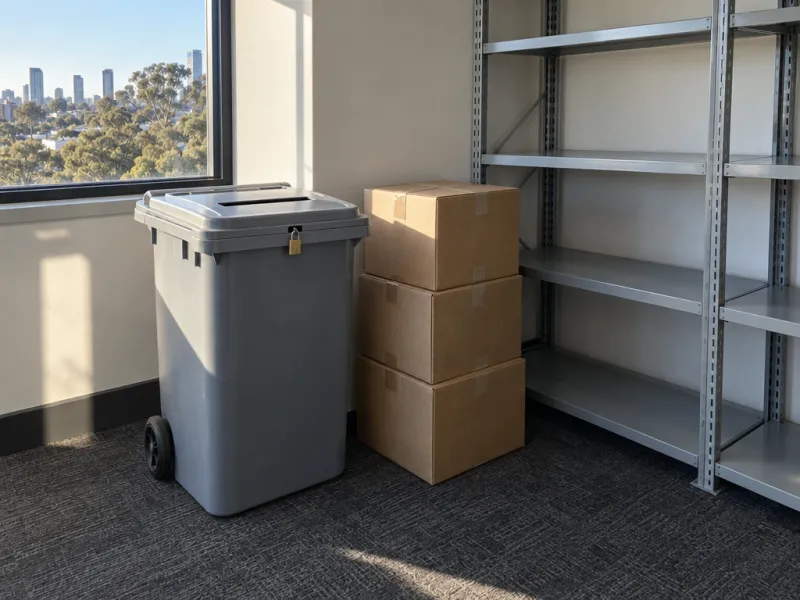
Not every sheet needs shredding. For non-sensitive paper and the cardboard a move produces, the Hills Shire Council's waste management page for businesses points to the NSW EPA business recycling directory and lists paper, cardboard and e-waste as recyclable. Fees may apply and the council says to call ahead. The nearest resource recovery facility it names is Remondis, 29 Powers Road, Seven Hills.
Drives, laptops and USB sticks: why deleting is not destroying
Deleting removes only the pointer to the data, which can be recovered until overwritten.
Deleting a file does not destroy it, because deleting only removes the pointer to the data, which can be recovered until overwritten.
Digital destruction means sanitising or physically destroying the media, and finding every copy in backups, the cloud and offsite storage. Think beyond the main computer: the old desktop under the reception desk, the external drive in the bottom drawer, the USB sticks in the stationery tub. The council lists e-waste as recyclable, but in our view a drive should be sanitised or destroyed before it goes anywhere near the recycling.
“all information about any routine procedures you have for destroying digital records”
Write the process down once. Among the records the ATO says you must keep is all information about any routine procedures you have for destroying digital records. A one-page note saying how old drives are wiped or destroyed, and who does it, covers that.
The order that works before packing day
- 1 Sort every record onto a shelf
- 2 Scan and back up what you will keep digitally, with an off-site copy
- 3 Destroy what can go: secure shredding for paper, sanitise or destroy old drives
- 4 Write down what was destroyed, when and how; file the destruction certificates
- 5 Label the must-keep boxes and set them apart
- 6 Owner keeps the backups, passwords and the must-keep list
- Packing day
Finish the sort and the destruction before packing day. Once boxes start getting taped, a mixed carton of keep and discard is twice the work to untangle.
Sort first, using the shelves above. Scan and back up anything you are moving to digital. Send sensitive paper to secure destruction, and wipe or destroy old drives. Then write down what was destroyed, when and how, and file the certificates with that note.
Last, label the must-keep boxes clearly and set them apart. Those are the boxes a removalist carries, and a plain label keeps them out of the discard pile in the rush. The backups, the passwords and the list of must-keep boxes are better staying with the owner on the day. Our office move checklist for Hills District businesses covers everything else to update and lift.
Count the boxes that stay, then ask for a quote
A good clear-out tells you the real size of the move: the must-keep archive boxes, the furniture and the equipment, with the shredding and recycling already gone. That count is what any removalist needs to plan the truck, and our guide to one trip or two shows why load size matters.
When the shelves are sorted, request a quote from Castle Hill Removals and tell us how many boxes are staying with you.
Sources
- Overview of record-keeping rules for business, Australian Taxation Office
- Records to keep for longer than five years, Australian Taxation Office
- Record-keeping, Fair Work Ombudsman
- Employee records, business.gov.au
- Record keeping, business.gov.au
- Protect your customers' information, business.gov.au
- Compliant destruction of Australian Government information, National Archives of Australia
- Mandatory injury register, SafeWork NSW
- Waste management for your business, The Hills Shire Council
- Pictures in this guide are illustrations, not photos of our jobs.
Ready for the walk-through?
Tell us about the house, the garage and the dates. We come back with the right crew, the real hourly rate and how the day runs. No phone tag, no obligation, and nothing is booked until you say so.